
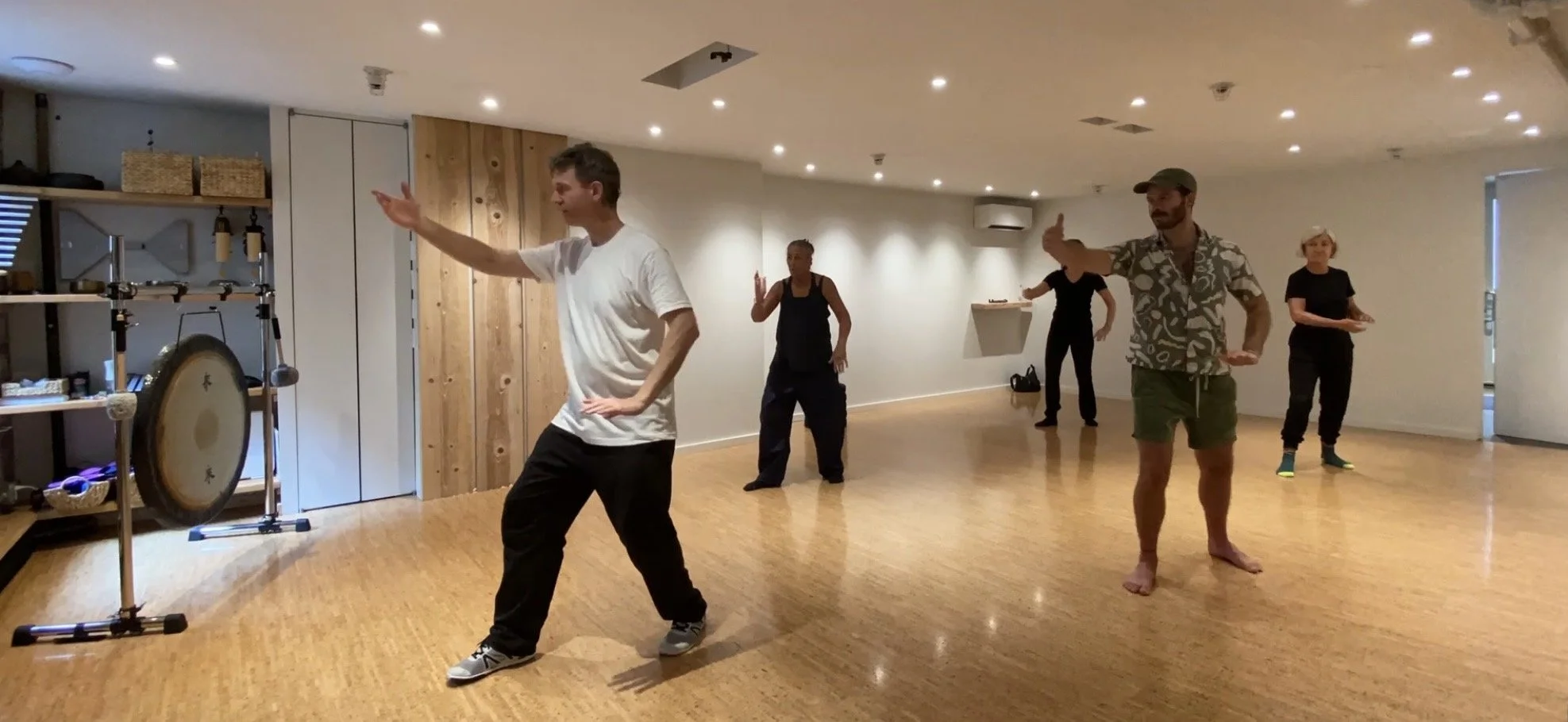
Function Over Form: What Your Walk Reveals About Your Health
There's something you can learn about a person just by watching them cross the street.
Not their posture or whether their spine looks perfectly stacked or their shoulders are squared.
What you're actually watching for is whether the whole thing moves together, whether there's a quiet rhythm to it, a coordination that happens without them thinking about it.
Some people have it, even if their structure looks far from perfect on paper. And some people don't, even though they look completely fine standing still.
That gap, between how the body looks and how the body actually works, is at the heart of what these ancient Chinese practices like Qi Gong, Ba Gua and Tai Chi are designed to address.
The Insight That Changes Everything
I've been spending time recently assisting at an acupuncture clinic upstate, working alongside a colleague who has been in clinical practice for close to two decades. We're treating patients back to back with acupuncture, Tui Na, Qi Gong, herbs, and qi gong exercises sent home with people as their physical therapy homework. It's a busy, thriving practice, and watching him work is amazing.
At one point during a session, he said something to a patient that stopped me mid-thought.
Function over form.
Three words. And they cut through about ninety percent of the confusion people carry about their bodies, about pain, about why certain things have stopped working the way they used to.
We've been conditioned, by fitness culture, by medicine, even by the way we talk about the body, to measure health by how things look. If a spine looks straight, it must be healthy. If posture looks good, the body must be working well. If an injury looks healed on an MRI, the problem must be gone.
But the body doesn't actually work that way, and these practices have always known it.
What My Teacher Tom Bisio Teaches About Integration
Tom Bisio, whose work sits at the foundation of everything I teach, addresses this directly in A Tooth from the Tiger's Mouth.
When he talks about recovering from injury, the goal isn't simply getting a body part to look right again, it's getting it to function in harmony with the rest of the body.
He makes the observation that injuries often create a break in the connection between the injured area and the whole. An injured knee becomes "my bad knee," something separate, something other. And that separation, even after the tissue heals, is where dysfunction lives.
Real recovery, real rehabilitation, stops that separation and it restores integration.
That's a fundamentally different way of thinking about the body than most people are used to. It's not about fixing a part- It's about restoring the whole.
This’s exactly why Qi Gong, Nei Gong, Tai Chi and Ba Gua Zhang take the approach they do.
Instead of simply targeting individual muscles or correcting isolated structural problems, these arts work to restore the inner coordination that should be running quietly in the background every time you move.
In one of Toms programs, Tian Gan Nei Gong he teaches that physical therapy and massage can relieve pain and restore movement potential, but they often don't restore the neuro-muscular wiring that generates proper internal movement. Without that restoration, some of the dysfunction remains.
This can go on for a lifetime, and often does.
Your Gait Is a Window Into Everything
Of all the ways to observe whether that integration is actually happening, gait, the simple act of walking, is one of the clearest.
Think about what a single step is supposed to involve. When the body is working correctly, a step isn't just a foot touching the ground. The whole spine rotates gently with each stride. The tissues breathe, blood and fluids move through areas that would otherwise stagnate, circulation reaches into the corners of the body that sitting all day has cut off.
There is, when everything is communicating, a symphony of movement that unfolds with every step, and you don't have to think about it at all.
But when that integration breaks down, whether from old injury, chronic tension, years of compensatory patterns, or simply from the disconnected way most of us have learned to live in our bodies, the step becomes mechanical. Parts move, but the whole doesn't.
You can see it, and more importantly, you can feel it.
What Ba Gua Zhang Research Actually Shows
In The Art of Ba Gua Zhang, Tom cites research comparing longtime Ba Gua practitioners to healthy non-practitioners doing the same exercise. Twelve minutes of quick walking.
The results were impressive. The Ba Gua group walked faster, with lower heart rates and lower blood pressure. Not because they were more fit in the conventional sense, but because decades of practice had cultivated a different quality of movement at the deepest level.
The research also found that Ba Gua circle walking burns significantly more calories than normal walking, because the rotational, spiral nature of the movement engages the entire body in a way that ordinary linear walking just doesn't.
Tom also describes how the slow, deliberate Mud Walking Step of Ba Gua (similar to Tai Chi walking) practice fully engages the body in controlling weight shifts from foot to foot, aligning the joints of the lower leg, and forging a connection all the way up through the body's energy centers in the Dantian and Mingmen (the lower basin of the torso.)
The body isn't just moving, it's communicating with itself.
That's function from the inside out.
Why Form So Often Follows Function (Not the Other Way Around)
Here's the thing that surprises people when they first start working with these practices..
You don't need your body to already look a certain way to benefit. You don't need perfect posture going in. You don't need a structurally ideal body, or a clean bill of health, or anything resembling what "correct" is supposed to look like.
What the internal arts work on is the restoration of coordination, of inner communication, of the self-organizing intelligence the body has always had access to.
Through self-observation, through breath, through the kind of relaxed, focused attention that Qi Gong and Nei Gong cultivate, the body begins finding its way back. Not because you forced it into the right shape, but because you gave it the conditions to remember how to work.
As an example, the Tian Gan Nei Gong system works specifically with the natural spiral movement patterns that run throughout the body. Injury and aging can reduce or even eliminate these spirals, leading to dysfunctional movement that both creates and maintains patterns of pain, reduced flexibility, and reduced range of motion. Tian Gan exercises restore those patterns, not by overriding the body, but by teaching it to move correctly again, from the inside.
And when function returns, form often follows on its own.
Posture improves because the body is actually integrated, not because someone told it to stand up straight. The gait becomes fluid because the whole system is communicating, not because any single part was corrected. The symphony returns.
This Is Original Functional Medicine
There's a lot of talk today about "functional medicine," and most of it is fine. But the principles these Chinese arts operate on are the original version, refined over centuries of clinical observation and practice. The idea that the body is an organic whole, that no part can truly be treated in isolation from the rest, that restoring function is both the goal and the measure of health, none of that is new. It's just that we drifted away from it.
Watching patients move through that upstate clinic and the people I work with in my classes and teaching one on one, watching them arrive guarded and leave lighter, watching the body respond to intelligent, integrated care, it's a reminder of what these practices have always been about. Not perfection or performance but function.
If something isn't working the way it should, the question isn't always what does it look like? The better question is, is it connected? Is it communicating? Is the whole thing moving together?
Start Working With This
If any of this is ringing true, the good news is you don't have to wait until something breaks down to start. Qi Gong, Nei Gong, Ba Gua Zhang and Tai Chi are all accessible practices that meet you where you are and build from there.
My classes at in Greenwich Village, New York City are a good place to begin. Private sessions are also available if you want more personalized attention.
Jonathan is the founder of Root of Movement Internal Arts and teaches Ba Gua Zhang, Qi Gong, and Internal Martial Arts at The Qi Center in New York City. He studied under Tom Bisio, whose books A Tooth from the Tiger's Mouth and The Art of Ba Gua Zhang are cited throughout this post.

How To Do What You Want For As Long As Your Want
I have friends and colleagues in their 50's and 60's who move and feel better than some of my clients in their 20's and 30's. Here’s what they do different.
In fitness these days most people think exercise means going as hard, fast and intense as possible.
The "No Pain, No Gain!" mentality.
The fixation on burning calories or pushing yourself beyond measure tends to damage and deplete the body and organs in ways that aren’t always so obvious.
And most think that feeling sore, tight and achy is “normal” - it’s what it takes to be “healthy”.
But unless you’re a competitive athlete, it’s a short sighted way of staying fit for most adults.
You really need to ask yourself what’s your end goal?
Is it simply to live in a state of pain and discomfort just to look good, or is it to be able to do what you want, when you want for as long as you want?
The older people I train with who display power, control, balance and agility work out hard sometimes, but mostly they focus on refined strength that’s built over time.
They’re training for today but considering how they’ll feel tomorrow and decades from now.
Refined strength and freedom of movement is something that’s cultivated using focus, patience and consistency.
They’re not just focused on their body and how it looks but how it’s connected to every other aspect of their life experience.
They’re aware that how they move is a reflection of their mental state, and how their mental state also reflects how they move.
They study the relationship and harmony of their body mind & spirit, everyday.
The latest and greatest exercise routines out there are oftentimes not a recipe for longevity and true health and fitness.
Taking some time out to consider what you truly want for your future self is worthwhile investment of your time.
Because having a body mind that functions and performs well, and with more control and freedom into your 60's, 70's, 80's and beyond is done in a nurturing way, not a violent and aggressive way.
Here are a few things to consider as you go into your next workout or activity:
Can you feel your whole body contribute to the movement/exercise you’re performing. (This will require focus and global awareness of your body)
See if you can perform the movement while keeping the breath slow, deep, even and without force.
Look for quality and precision over quantity and intensity.
If you apply these ideas consistently, and observe your results, you’ll find clarity on how to make the movement better, and you’ll experience more longevity and comfort as you continue to move forward in your life!
The path to true health and vitality lies not in pushing our bodies to the limit, but in nurturing them with mindful, balanced practices that serve us today and preserve our well-being for the years to come.

Say Hello to Qi Gong: Your New Best Friend for Pain-Free Living
Qi Gong: Your New Best Friend for Pain-Free Living
Life sure is a crazy ride, isn't it? Between juggling work, family, and everything in between, our health sometimes takes a backseat. If you're in your 30's, 40’s or 50’s, chances are you've had a run-in or two with annoying orthopedic pain. And, let's face it, the thought of popping pills or going under the knife doesn't exactly sound like a fun day at the beach. But guess what? There's another way to kick that pain to the curb – and it's called Qi Gong (sounds like Chee Gung).
The Struggle:
Ladies, we hear you. Between raising the kids and running the world, who has time to focus on their own health? But neglecting ourselves can lead to nasty issues like neck, shoulder, and back pain. And it's pretty hard to strut your stuff in Zumba class when your back is killing you. Fellas, we haven't forgotten you. We know it's frustrating when pain gets in the way of hitting that perfect golf swing or romping around with the kids.
Meet Qi Gong - Your Pain Buster:
Now, you might be scratching your head and thinking, "Qi Gong? What's that? Isn’t that for old people?" Let's break it down. Qi Gong is an ancient Chinese practice that's all about slow, deliberate movements, deep breathing, and focusing the mind. The goal is to balance your body and mind - from head to toe.
In essence, Qi Gong is like your body's personal energy factory and self-applied massage and chiropractic treatment from inside out. It works to amp up your body's natural healing abilities, balance and aligns the musculoskeletal system, physiology, body’s natural rhythms.
Why Qi Gong Beats Other Options:
Sure, physical therapy and other treatments have their perks. But Qi Gong takes things a step further. It's not just about curing what ails you physically - it's about getting your mind and spirit in on the action too. By unlocking your body's 'Qi' or 'life energy', Qi Gong helps you kickstart your body's self-healing process, alleviate pain, improve your posture, and boost your flexibility.
Also, it’s not about just resolving the issues you’re dealing with today, it’s about preventing future problems as well. Qi gong helps to reprogram the way you move through life. It restores the natural, intrinsic movement you likely once had but los, so that you approach the activities of your life with more stability, agility and ability.
Qi Gong – A Long-Term Buddy:
Here's the best part – Qi Gong is sustainable. You can take things at your own pace and still reap the benefits. Whether you're an athlete, performer or a newbie, Qi Gong is your ticket to managing orthopedic pain naturally and long-term. Regular practice is incredibly empowering and can help you take charge of your life and get back to doing what you love – pain-free!
Wrap Up:
So, there you have it. Beating orthopedic pain doesn't have to mean a trip to the operating room, reliance on doctors and therapists or a lifetime prescription. With Qi Gong, you can live a healthier lifestyle, manage pain naturally, stay more focused and energized and regain your confidence.
If you want to learn more or you’re ready to start your journey to managing pain yourself then get ready to experience the Qi Gong transformation. Get in touch with us and let’s see if Qi Gong can help you.
Keywords: Qi Gong, orthopedic pain, natural remedy, life energy, body and mind balance, chronic pain relief, improved posture, flexibility, overall health, drug-free approach.